Posted by Dan DaSilva on April 16th, 2010 | 
(Reuters AlertNet) April 16, 2010 – NEW DELHI – Migration to major cities in India is on the rise, thanks to increasingly unpredictable rains and fluctuating farm income, and is complicating an old battle: that to eradicate polio.
India is one of just four countries – including Nigeria, Pakistan and Afghanistan – that have never managed to eradicate the disease, which paralyzes a share of those who contract it.
India’s government and private organizations have waged a long and often innovative effort to change that, and have made dramatic strides in states like Bihar, where improved governance has helped lead to a dramatic drop in cases.
But in a nation with a long history of worker migration, growing climate-related movement threatens to undo some of the gains, particularly since migrants often end up in slums with poor sanitation, where chances for transmission of the virus are high.
The problems facing Parvati Devi, a mother of three now living in Delhi’s slums, suggest what may be ahead for India’s polio battle.
Continue reading this post »
Posted by Kayly Ober on April 13th, 2010 |
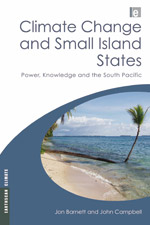 Geographers Jon Barnett and John Campbell bring climate change impacts in small island states to the fore with their new aptly-named book Climate Change and Small Island States. Not that island states didn’t already enjoy popular attention, as the book’s description suggests: Geographers Jon Barnett and John Campbell bring climate change impacts in small island states to the fore with their new aptly-named book Climate Change and Small Island States. Not that island states didn’t already enjoy popular attention, as the book’s description suggests:
Small Island Developing States are often depicted as being among the most vulnerable of all places to the effects of climate change, and they are a cause célèbre of many involved in climate science, politics and the media. Yet while small island developing states are much talked about, the production of both scientific knowledge and policies to protect the rights of these nations and their people has been remarkably slow.
This book is the first to apply a critical approach to climate change science and policy processes in the South Pacific region. It shows how groups within politically and scientifically powerful countries appropriate the issue of island vulnerability in ways that do not do justice to the lives of island people. It argues that the ways in which islands and their inhabitants are represented in climate science and politics seldom leads to meaningful responses to assist them to adapt to climate change. Throughout, the authors focus on
the hitherto largely ignored social impacts of climate change, and demonstrate that adaptation and mitigation policies cannot be effective without understanding the social systems and values of island societies.
This publication is, as Barry Smit, Canada Research Chair in Global Environmental Change at University of Guelph points out, “a timely check on established paradigms and their effectiveness (or otherwise) in contributing to practical adaptation to climate change in vulnerable regions.”
Continue reading this post »
Posted by Dan DaSilva on March 31st, 2010 |
 If you are located in or near the New York City area, If you are located in or near the New York City area,
there is a one-day public seminar on Environmentally Induced Migration and Climate Change at the UN Headquarters on April 20th. It is being put on by the United Nations Institute for Training and Research (UNITAR) as part of their Migration and Development seminar series. The 2010 series is organized in collaboration with the International Organization for Migration (IOM), the United Nations Population Fund (UNFPA) and the MacArthur Foundation.
The seminar features renowned experts from governments, the United Nations system, the International Organization for Migration, other
international organizations and civil society. Following their presentations, participants have an opportunity to engage in in-depth discussions with the speakers.
The event is targeted to members of permanent missions to the United Nations in New York, who work on climate change, migration or development issues, as well as those in civil society with academic or professional interest in the topic. Visit the website for more information and to register.
Posted by Dan DaSilva on March 30th, 2010 |
(IRIN) March 30, 2010 – JOHANNESBURG, The hapless people flooding ports and airport terminals in developed countries are occasionally seen as “environmental migrants” or even “environmentally induced migrants”, fleeing natural disasters in their part of the world.
Now, some countries have begun turning this displacement into a positive learning experience by providing such migrants with temporary work permits to help them earn an income and acquire skills, making them more resilient when they return home.
“Extending work visas or granting temporary visas to people from countries … hit by natural disasters is often
used in … Europe and North America,” said Koko Warner, head of the Environmental Migration, Social Vulnerability and Adaptation Section at the UN University, and such initiatives were part of a “wider trend in managing the impacts
of natural hazards and migration”.
The US Immigration and Nationality Act allows Temporary Protected Status (TPS) to foreign nationals already in the US because of an environmental disaster, provided their country is unable to handle their return.
There are no international laws protecting people forced to move across borders by more intense natural disasters as a result of climate change, but Walter Kälin, Representative of the UN Secretary-General on the Human Rights of Internally Displaced Persons, cited the Finnish Aliens Act, which also “provides temporary protection (up to three years) in situations of mass displacement as a result of an environmental disaster.”
Continue reading this post »
Posted by Dan DaSilva on March 24th, 2010 |
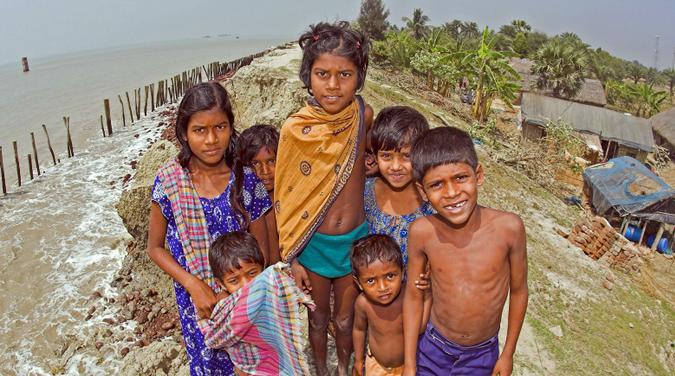 Photo credit: Mikkel Stenbæk Hansen The European Environmental Agency has put up a small slide show of photos of people from the Sundarbans affected by both
the sudden and creeping effects of climate change. The Sundarbans is located across areas of Bangladesh and West Bengal, India. This slide show is part
of their ‘Signals’ report which they publish at the start of each year. It provides snapshot stories on issues of interest both to the environmental policy debate and the wider public for the upcoming year.
See the slideshow »
Posted by Dan DaSilva on March 17th, 2010 |
The German Marshall Fund (GMF) based in Washington, DC launched an initiative last June to examine the link between climate change and migration and address its knowledge gaps. This project is now one of many researching this topic and has gathered leading experts in the field. Its core mission is to bring the topic to the attention of policymakers, stakeholders, and the general public.
I came across this excellent blog post by Jared Banks, a US Foreign Service Officer and a member of the International Migration Office in the Bureau of Population, Refugees, and Migration. He is part of the GMF
Transatlantic Study Team investigating the impact
of climate change on migration patterns around the world. Recently, he has traveled to Senegal to study first-hand the impacts that the environment has on the vulnerable population.
You can check out his brief blog post here. A final report by GMF, providing a review of findings and recommendations to policymakers and stakeholders will be published in June, 2010.
|
|