(Yale Environment 360) January 27, 2010 – Danish photographer and filmmaker Jonathan Berg Moller recently spent nine months in Bangladesh, chronicling the lives of people struggling to survive just a few feet above sea level. He traveled to the South Asian nation after hearing projections from the Intergovernmental Panel on Climate Change about the millions of climate refugees that would be created this century by rising seas and more powerful storms. Moller wanted to put a human face on this issue, and decided there was no
better place than Bangladesh, where 15 million of its 160 million people live less than three feet above sea level.
While he was in Bangladesh, Cyclone Aila struck, killing roughly 200 people and leaving thousands homeless. Moller proceeded to document the devastation from that 2009 storm, as well the impact of subsiding land and rising seas on other Bangladeshis, many of whom earn less than $1 a day. In this Yale Environment 360 report, we present two videos by Moller – “Aila’s Victims” and “Wahidul’s Story.”
Moller says he will leave it up
to scientists to determine how much of the suffering he portrays is related to a warming climate. “I am not a scientist and I know that global warming is a contentious issue,” he says. “I wanted to focus on the people who are suffering today. The point is that these people are vulnerable today, and will become even more vulnerable in the future.”
A Bangladeshi man who is the subject of one of his videos, Wahidul, lives in the town of Kuziartek, which was once home to 40,000 people. Now, the island on which Kuziartek was located is underwater. All that is left of Kuziartek is a small embankment rising from the sea, 2 ½ miles out in the Bay of Bengal. Seven families remain there, including Wahidul’s, clinging to a disappearing strip of earth.
“But what can we do,” asks Wahidul, fearful that abandoning his village would leave him homeless in a city slum. “We have an unfortunate fate. There are many people in the world, but I doubt that anyone must suffer as much as me. People shouldn’t live where we live, but we have no choice. We have to live here.”
2010 as an entry to the ExchangesConnect 2009 Video Contest ‘Change Your Climate, Change Our World’. This film highlights the impacts of climate change in the Sundarbans, which is located across areas of Bangladesh and West Bengal, India. The rising sea level has already claimed an island leaving over 10,000 people homeless and sending fresh waves of climate
migrants every year.
The film also offers solutions, highlighting the urgency for mitigation and adaptation efforts and creation and implementation of adaptation funds to help these people combat the effects of climate change better.
Following the earthquake, there has been much discussion for granting special refugee or immigrant status to those affected in Haiti. Here is a good article on this by TIME as well as another article by the Washington
Times. A last one is by a fellow blogger Finn Myrstrad. He made a good post about temporary protection for Haitians. Let us know your views on this issue in the comment section.
For readers interested in contributing to help victims of the earthquake in Haiti, here is a great website which lists places to donate online. All links are legit and lead to a page with additional information on donating to the relief fund.
Here are some additional listings of well known humanitarian agencies I often refer to on this blog, that are accepting donations for disaster
(Munich Re Foundation) The Munich Re Foundation and the United Nations University Institute for Environment and Human Security (UNU–EHS)
announce the fifth annual Summer Academy on Social Vulnerability. The theme of the 2010 Summer Academy is “Protecting environmental migrants: creating new policy and institutional frameworks”.
Applications are required to be submitted online at www.ehs.unu.edunot later than 15 January 2010.
The Summer Academy is designed to bring Ph.D, LLM and SJD students together with senior United Nations University
and Munich Re Foundation scientists, international experts, and academic professors to facilitate the mutual exchange of research and scholarship on climate change and social vulnerability. The 2010 program will invite a group of outstanding students from graduate programs around the world to participate with experts in mapping a set of potential policy and institutional frameworks to help address the humanitarian and human rights impacts of forced migration related to climate change.
The week-long program will focus on specific country and regional level challenges related to human migration and displacement, with a view to identifying the gaps in policy, law and institutions needed to protect vulnerable groups.
Further information
For further information please download the Announcement for the Summer Academy 2010 or contact Ms. Xiaomeng Shen (shen@ehs.unu.edu) at UNU-EHS.
(The New Republic) January 4, 2010 – Joanna Kakissis has a nicely reported piece in The New York Times today on climate-driven migration in developing countries. The concept’s pretty simple: As the planet heats up, many regions are expected to see more frequent (and more severe) floods, droughts, and storms, which will uproot a bunch of people, especially in rural areas. So we’re likely to see many more stories like this one:
Mahe Noor left her village in southern Bangladesh after Cyclone Sidr flattened her family’s home and small market in 2007. Jobless and homeless, she and her husband, Nizam Hawladar, moved to this crowded megalopolis, hoping that they might soon return home.
Two years later, they are still here. Ms. Noor, 25, and Mr. Hawladar, 35, work long hours at low-paying jobs—she at a garment factory and he at a roadside tea stall. They are unable to save money after paying for food and rent on their dark shanty in Korail, one of the largest slums in Dhaka. And in their village, more people are leaving because of river erosion and dwindling job opportunities.
“We’re trapped,” Ms. Noor said.
In the past, many analysts argued that climate-driven migration would lead to tens of millions of “climate refugees” pouring into wealthy countries. Droughts in North Africa, say, would push people into Europe. (This explains why some European anti-immigration groups have adopted green rhetoric.) But more recent research suggests that most of the migration will take place within developing countries—from rural areas to cities. And the main worry here is that these cities are already swelling exponentially, and their infrastructure can barely keep up, which is why many “megacities” sport massive slums.
(New York Times) January 3, 2010 – DHAKA, BANGLADESH – Mahe Noor left her village in southern Bangladesh after Cyclone Sidr flattened her family’s home and small market in 2007. Jobless and homeless, she and her husband, Nizam Hawladar, moved to this crowded megalopolis, hoping that they might soon return home.
Two years later, they are still here. Ms. Noor, 25, and Mr. Hawladar, 35, work long hours at low-paying jobs – she at a garment factory and he at a roadside tea stall. They are unable to save money after paying for food and rent on their dark shanty in Korail, one of the largest slums in Dhaka. And in their village, more people are leaving because of river erosion and dwindling job opportunities.
“We’re trapped,” Ms. Noor said.
Natural calamities have plagued humanity for generations. But with the prospect of worsening climate conditions over the next few decades, experts on migration say tens of millions more people in the developing world could be on the move because of disasters.
Rather than seeking a new life elsewhere in a mass international “climate migration,” as some analysts had once predicted, many of these migrants are now expected to move to nearby megacities in their own countries.
“Environmental refugees have lost everything,” said Rabab Fatima, the South Asia representative of the International Organization for Migration. “They don’t have the money to make a big move. They move to the next village, the next town and eventually to a city.”



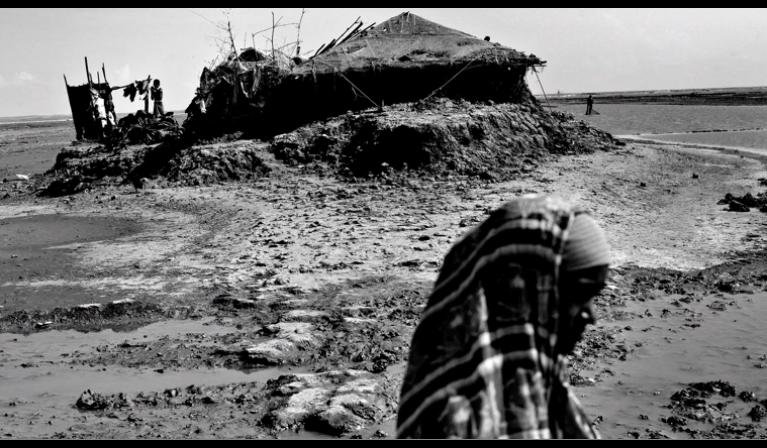 (Yale Environment 360) January 27, 2010 – Danish photographer and filmmaker Jonathan Berg Moller recently spent nine months in Bangladesh, chronicling the lives of people struggling to survive just a few feet above sea level. He traveled to the South Asian nation after hearing projections from the Intergovernmental Panel on Climate Change about the millions of climate refugees that would be created this century by rising seas and more powerful storms. Moller wanted to put a human face on this issue, and decided there was no