The UN Development Programme’s Human Development Report 2009 (HDR), entitled “Overcoming Barriers: Human Mobility and Development” was released simultaneously across the world yesterday. The report “makes a strong case for removing barriers to migration within and across borders, arguing that human movement had brought perceptible all-round benefits and held the potential to improve the lives of millions of poor and low-skilled people” (The Hindu).
According to the report, “Nearly one billion – or one out of seven – people are migrants. The 2009 Human Development Report demonstrates that migration can improve the lives of millions of people: the ones who move, those in destination communities and others that remain at home. The findings in this Report cast new light on some common misconceptions on migration, proposing a series of
migration policies that can allow migration – both within and between countries – to increase people’s freedom and improve the lives of millions around the world.”
The report comes at a time when experts and researchers from the international community are urging policymakers to reject misconstrued fears about environmental migration, instead adopt a more positive view towards people displaced by the effects of climate change by accommodating for future populations through increased development of destination hubs and also resilience programs at migrant origins. Here is a link to related news stories about the 2009 HDR from countries around the world, and the views on the findings. Below is a great introduction video which highlights the theme of the report with interviews of migrants from various countries.
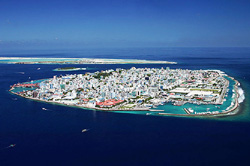
Male, the capital of the Maldives. With an average ground level of 1.5 metres above sea level, it is the country with the lowest highest point in the world, at 2.3 metres. Photo credit: Wikimedia Commons
(IRIN) October 5, 2009 – Up to half a million people in the Pacific will lose their homes and their countries to rising sea levels because small island nations cannot persuade the rest of the world to reduce greenhouse gas emissions sufficiently, campaigners say.
The Alliance of Small Island States (AOSIS) is calling for a significant reduction in global emissions so the world’s temperature does not rise more than 1.5 degrees centigrade above pre-industrial levels.
But after a week of negotiations in Bangkok before the UN Climate Change Conference in Copenhagen in December, developed and developing world countries have been unable to agree anything at all on emissions cuts, AOSIS said.
“We are not working through the options as negotiations, we are simply restating our positions. So we may arrive in Copenhagen with the parties still very far apart. It’s really setting up Copenhagen for failure or an inadequate result,” Leon Charles, chairman of the AOSIS negotiating team, who is from the Caribbean island of Grenada, told IRIN.
AOSIS, whose members are among the most vulnerable to climate change, “can’t live with” global temperature rises of two degrees, a possible target mentioned in the Bangkok talks, Charles said.
“We want 1.5 degrees centigrade in terms of mitigation and significant scaled-up and easily accessible finance. It’s about our survival,” he said.
An AOSIS statement issued after a preliminary meeting in New York in September said members were “profoundly disappointed” by the lack of will in the negotiations to protect small island developing states from climate change impacts.
Relocation issues
Campaigners said AOSIS’s prospects were dim, calling instead for more attention on how and where people from submerged countries would be relocated.
The Climate Change, Environment and Migration Alliance (CCEMA) was initiated in April 2008 at an expert meeting in Munich, Germany. The CCEMA has just launched their portal website which lists the aims and objectives and also has current news and event listings. According to the website, “The major aim of CCEMA is to mainstream the environmental and climate change considerations into the migration management policies
and practice and to also bring migration issues into the world’s on-going environmental and climate change discourse”. As such, CCEMA will provide an essential platform to (1) raise awareness, (2) improve the knowledge base, (3) provide neutral and open forum policy dialogue and, (4) provide practical support (ccema-portal.org).
This alliance is the first ever of its kind and is reflective of the momentum that the climate change and human mobility discourse has gained over the past two years. The actions of the CCEMA will no doubt contribute in many ways to a better understanding of the size and characteristics of issue, leading to concrete and long-term solutions.
Over the past few weeks, climate migration as exaggeration has been a popular refrain. Most notably, in a recently published article in Environment and Urbanization, where Dr. Cecilia Tacoli, senior researcher at the International Institute of Environment and Development, further makes the case that climate-induced migration projections are wildly inflated. Why, you ask yourself, would a pro-recognition organization analyze and disseminate an article that so flies in the face of its mission? The answer is simple: we are after facts. Facts that lead to real progress. And, in this regard, Dr. Tacoli forces us to acknowledge that “there is a real risk that alarmism will divert attention from real problems, resulting in policies that fail to protect the most vulnerable people.”
Dr. Tacoli is also of the growing chorus of analysts who cite migration as adaptation rather than as negative consequence. Ultimately, she says, “the failure to recognise the role of voluntary migration in adapting to climate change contributes to crisis-driven movements that inevitably increase the vulnerability of those forced to leave their homes and assets as they flee conflict and disaster…It is worth remembering that supporting migrants can ultimately help reduce the numbers of refugees.”
Below is a complete summary of Dr. Tacoli’s views for the BBC’s The Green Room in an article entitled “Climate migration fears ‘misplaced”.
Here is the recorded webcast from the panel discussion last week entitled “Emerging Policy Perspectives on Human Mobility in a Changing Climate”. It was put on by the UN University Office at the UN New York during Climate Week in NYC. The three objectives of the panel were to increase public awareness about the impact of climate change on human migration and displacement, identify key patterns in research, and identify the most urgent policy issues that are emerging.
This first panel of two goes for about an hour and twenty minutes. The speakers included:
Susan F. Martin – Director of the Institute for the Study of International Migration in the School of Foreign Service at Georgetown University
Koko Warner – Head of the Environmental Migration, Social Vulnerability, and Adaptation Section at the United Nations University Institute for Environment and Human Security (UNU-EHS)
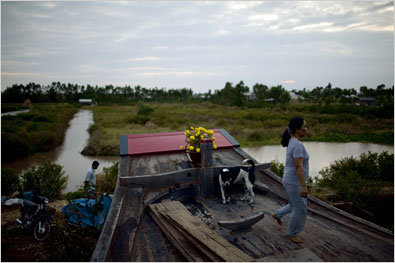
(New York Times) September 23, 2009 – CAI RANG, Vietnam – For centuries, as monsoon rains, typhoons and wars have swept over them and disappeared into the sunshine, the farmers and fishermen of the Mekong Delta have drawn life from the water and fertile fields where the great river ends its 2,700-mile journey to the sea.
The rhythms of life continue from season to season though, like much of the country, the delta is moving quickly into the future, and industry has begun to pollute the air and water.
But everything here, both the timeless and the new, is at risk now from a threat that could bring deeper and longer-lasting disruptions than the generations of warfare that ended more than 30 years ago.
In a worse-case projection, a Vietnamese government report released last month says that more than one-third of the delta, where 17 million people live and nearly half the country’s rice is grown, could be submerged if sea levels rise by three feet in the decades to come.



 The UN Development Programme’s Human Development Report 2009 (HDR), entitled “Overcoming Barriers: Human Mobility and Development” was released simultaneously across the world yesterday. The report “makes a strong case for removing barriers to migration within and across borders, arguing that human movement had brought perceptible all-round benefits and held the potential to improve the lives of millions of poor and low-skilled people” (The Hindu).