The passing of Refugees International President, Ken Bacon, came just days after the announcement that he and his wife Darcy Bacon, have provided seed money to establish a new center at Refugees International to assist people displaced by global climate change. In the last few months of his life, Mr. Bacon turned his passion towards the growing threat of climate displacement. If you don’t know about Ken Bacon and his work, check out the news article below.
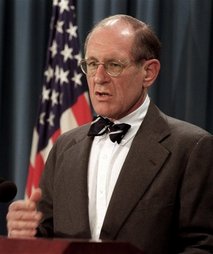
(CNN) August 15, 2009 – Kenneth Bacon, a former reporter and Pentagon spokesman who later served as a top advocate of displaced people all over the world, died Saturday, according to Refugees International. He was 64.
Bacon had served as the president of Washington-based Refugees International since 2001, the group said in a statement Saturday. The former Wall Street Journal reporter died Saturday morning from an aggressive melanoma that spread to his brain, the statement said.
Secretary of State Hillary Clinton called Bacon, who was Pentagon spokesman during the Clinton administration, a “great humanitarian leader.”
“Most Americans remember Ken as the unflappable civilian voice of the Department of Defense, where he served with distinction as spokesperson for many years,” Clinton said in a statement. “But for millions of the world’s most vulnerable people — refugees and other victims of conflict — Ken was an invaluable source of hope, inspiration and support.
Refugees International credited Bacon for doubling the group’s size under his leadership and helping it get increased protection and assistance for displaced people in Sudan’s Darfur region, Iraq, Pakistan and other troubled areas. In the last months of his life, Bacon shifted his focus toward the issue of climate displacement, the group said.
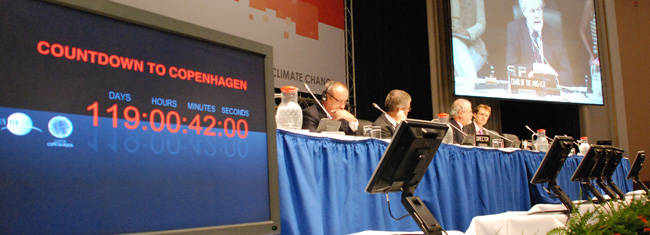
Here is an update for those of you that are following the lead up to the UN Climate Change Conference in Copenhagen (COP15) this December. More than 2,000 representatives met at the latest round of the Climate Change Talks, which took place on August 10-14. The committee had the current revised version of the negotiating text in front of them, which is to be fully agreed on by COP15 in order for a post-Kyoto climate deal to take place.
There was a single sentence that was inserted in the previous version of the negotiating text proposed at the June Climate Change Talks, which relates to environmental migration. It calls on nations to implement plans to adapt to climate change by accounting for these possible migrations. This sentence was found in subparagraph 25(e) and stated at the time:
“Activities related to national and international migration/planned relocation of climate
refugees.”
Since then, subparagraph 25(e) has been updated/expanded to the following:
“[Activities related to national and international migration/planned relocation of climate
[refugees] [migrants] [displaced persons by extreme climate events].]
Alternatives to subparagraph 25 (e):
Alternative 1
[Activities related to national and international responses to people displaced by the impacts of climate change]
Alternative 2
[Activities related to national and international migration and displacement or planned relocation of persons affected by adverse impact of climate change]
Alternative 3
[Activities related to national and international migration/planned relocation of displaced individuals and peoples due to the adverse effects of climate change]”
It should be noted that every entry in the negotiating text which is contained in [square brackets] is an indication that it’s an unresolved issue. As you can see, there is still no solid agreement on this specific entry in the negotiating document. Instead, many still unagreed alternative sentences are presented.
Briefing the media on the last day of the informal consultations in Bonn, UNFCCC Executive Secretary Yvo de Boer said that while selective progress had been made to consolidate the huge texts on the table, “at this rate, we will not make it”. “We seem to be afloat on a sea of brackets”, de Boer also said, referring to not only paragraph 25(e), but also the other unresolved issues in the text.
Work on the draft negotiating text will continue on September 28 in Bangkok at a two-week session. Delegates will then assemble for five days of pre-Copenhagen negotiations in Barcelona on November 2. The UN Climate Change Conference in Copenhagen takes place from December 7-18, 2009. Do you think there will be a formal agreement made in time regarding the provision and financing mechanisms to protect people displaced by the impacts of climate change?
Wael Hmaidan, executive director of IndyACT, The League of Independent Activists says climate change in the Middle East will affect Lebanon first. “The distribution of rain has changed; the snow density is decreasing and forest fires are spreading,” he said.
With less melt water from snow, the dry season is set to begin a month earlier. While disrupting some farming, particularly in the south and east where agriculture is the mainstay of the economy, environmentalists warn it will be urban areas which face the most serious water shortages over the next five years.
Two man-made factors add to Lebanon’s water shortage problems. Half of rainfall is currently lost through run-off, evaporation or ground seepage every year, while much of the plumbing and irrigation systems are still in disarray from the civil war and the 2006 July War.
So, what does this mean for the 400,000 Palestinian refugees that live in the country? (Of Lebanon’s roughly four million people, including around 400,000 Palestinian refugees, over 80 percent live in urban areas, with 1.5 million living in Beirut.) They will be migrants not only due to statelessness and conflict, but also climate change. Where will they go? It appears that no one has an answer.
(Refugees International) August 10, 2009 – Refugees International announced plans to establish the Ken and Darcy Bacon Center for the Study of Climate Displacement today. The Center will use Refugees International’s successful advocacy model to work towards stronger policies and structures that meet the needs of the tens of millions of people expected to be displaced by climate change in the coming decades.
“I wanted to make this gift to ensure that Refugees International’s mission can incorporate the global changes that will create displacement in future years,” said Ken Bacon, president of Refugees International since 2001, who is currently battling melanoma and is on leave. “Climate change will force millions of people from their homes and this will pose enormous challenges to an already stressed humanitarian system. Refugees International is uniquely situated to ensure these people don’t fall through the cracks.”
A generous donation by Ken and Darcy Bacon provided the seed money for the new center, which will be a new program within Refugees International. The UN Foundation, Refugees International board member and actor Sam Waterston, and other members of RI’s board of directors have matched their initial donation. Refugees International’s other priorities include improving the global response to neglected crises and internal displacement, increasing support for people who return home when wars end, strengthening UN peacekeeping efforts, and achieving citizenship for stateless people.
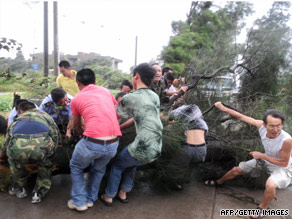
Residents gather to remove a fallen tree blocking a road in Changle, China, in Fujian province on Saturday. Photo credit: CNN
(CNN) August 10, 2009 – A deadly typhoon that slammed into China’s coastal provinces and Taiwan over the weekend has displaced nearly one million people and left dozens missing, state-run media reported Monday.
High winds and torrential rain of Typhoon Morakot hit coastal provinces Fujian and Zhejian hardest, and caused the worst flooding in decades in Taiwan — where flood waters as high as 7 feet were reported, China Daily reported.
The deadly typhoon swept across the Philippines and Taiwan’s Hualien region before crashing into eastern China, claiming nearly two dozens lives along the way, the newspaper reported.
The storm — measuring about 1,600 kilometers (about 1,000 miles) across — continued to pummel coastal China Monday, but forecasters said it is unlikely that Morakot would reach Shanghai, the country’s largest city, which sits further north along the coast.
Government officials expect the typhoon to cause more than 8.5 million yuan ($1.2 billion) in damages, the newspaper said.
Video from Taiwan showed a six-story hotel crashing into the floodwaters coursing below. The well-known hot springs resort had evacuated before the collapse.
At least seven people were killed, 32 wounded and 46 unaccounted for, according to Taiwan’s Central News Agency.
I posted a news article in May about how the village of Newtok, Alaska voted to relocate its 340 residents to new homes 9 miles away because of land degredation and flooding from permafrost melt. Below is a short video about this story by Powering a Nation; a News21 project by students of the School of Journalism and Mass Communication at the University of North Carolina at Chapel Hill. Click here to read the associated article.



 (
(