Posted by Dan DaSilva on July 11th, 2009 | 
In a recently published report, two academics from Oxford University have come up with the term “survival migrants” to accommodate groups who do not fall within the legal refugee definition in the 1951 Refugee Convention. Dr. Alexander Betts and his co-author Esra Kaytaz say that “survival migrants” are described as “forced migrants who are not eligible for the legal protection afforded by refugee status, but who nevertheless flee an existential threat to which they have no domestic recourse.” In his , Betts writes that sources of survival migration are likely to proliferate in the context of climate change and the transmission of the global economic meltdown. Yet both are not directly recognized in any existing convention.
In the report, the authors focus on a case study of Zimbabweans living in South Africa and Botswana. An estimated 2 million Zimbabweans have fled their country since 2005 – for many, resorting to the only available means of survival, Betts says (AlertNet.org).
According to Betts, only 10 percent of those Zimbabweans arriving in South Africa have been officially recognised as refugees. “The majority of Zimbabwean migrants – like an increasing number of migrants elsewhere in the world – have been forced to flee a combination of state failure, severe environmental distress, or widespread livelihood collapse, rather than as individuals fleeing political persecution as required by international refugee law.” Because of this, they have received limited legal protection and are extremely susceptible to poverty, harassment, and xenophobic attacks in South Africa and Botswana.
Although Betts admits it would be difficult to get states to endorse “survival migration” as a legal definition, he notes the success of protection regimes of people who are forced to migrate within their own borders, particularly the United Nations “soft law” document “Guiding Principles on Internal Displacement”, which was drafted in 1998. An attempt to address the needs of survival migrants could drawn upon this document.
“There are a number of reasons to be optimistic,” Betts said. “The new realities of forced migration – climate change, livelihood collapse, state collapse – underpin the fact that the definition of refugee under the 1951 convention is not adequate. There’s a growing acceptance that something needs to be done to supplement the convention.”
The paper, entitled “National and international responses to the Zimbabwean exodus: implications for the refugee protection regime”, will be available online on the UNHCR website in the coming weeks.
.
Related Links:
“Time to redefine refugees as ‘survival migrants’?” – Reuters AlertNet (July 2009)
“Definition of a refugee needs updating, report tells United Nations” – University of Oxford
– The GEGblog
Posted by Dan DaSilva on July 4th, 2009 |
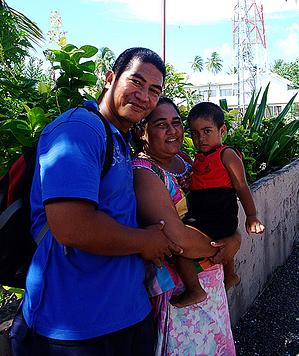 Photo credit: Creative Commons (Inside Story) June 30, 2009 – For people on Kiribati and Tuvalu facing increasing climate pressures, the description “refugee” has too many negative connotations, write Jane McAdam and Maryanne Loughry.
Over the past decade a new term has entered the lexicon of policy makers and the media: climate change refugees. Human movement caused by environmental factors – drought, land degradation or significant climatic events (like cyclones) – is not new; what is new is the number of people now thought to be susceptible to such pressures. In a recent report, The Anatomy of a Silent Crisis, Kofi Annan describes millions of people suffering – and ultimately being uprooted or permanently on the move – because of climate change. According to the UN High Commissioner for Refugees, it is becoming difficult to categorise displaced people because of the combined impacts of conflict, the environment and economic pressures.
The spectre of climate change has also focused attention on the small Pacific nations of Kiribati and Tuvalu. Straddling the equator, these former British colonies – once known as the Gilbert and Ellice Islands – gained their independence only three decades ago. In recent years they have featured in media reports as “sinking islands” that will be uninhabitable by the middle of this century, with their people becoming the world’s first “climate refugees.” Kiribati has a population of around 100,000, while Tuvalu, with only 10,000 people, is the world’s smallest state apart from the Vatican.
As researchers with an academic interest in forced migration, we recently visited Kiribati and Tuvalu. As we drove along the main road on the central Kiribati atoll of Tarawa, with the lagoon on one side and the ocean on the other, the sense of vulnerability was palpable – and that feeling is magnified when there is an extreme event like a cyclone or king tide. But are the apocalyptic projections about these two nations, and their people, accurate?
Continue reading this post »
Posted by Dan DaSilva on June 26th, 2009 |
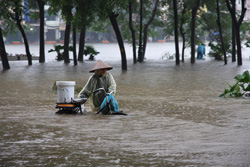 Natural disasters such as floods are set to intensify. Photo credit: Tung X. Ngo/IRIN (IRIN) June 25, 2009 – The debate on providing protection to possibly several million “climate refugees” displaced by the vagaries of nature is heating up.
Bangladesh, which may lose up to one-fifth of its surface area if sea levels rise by one metre, called for provisions in the immigration polices of industrial countries to accept “climate refugees” at the recent UN climate change talks in Bonn, Germany.
In the final days of the conference, the issue crept into the proposed negotiating text between industrialised and developing countries on how to reduce greenhouse gas emissions. The text, which will be debated over the next few months ahead of December’s big climate meeting in Copenhagen, Denmark, now includes a provision to provide “means to protect people displaced by the impacts of climate change”.
The mention in the proposed text, which will form the basis of the final climate deal, marks the start of debate on “climate refugees” in the “formal” talks, pointed out Saleemul Huq, head of the climate change group at the London-based International Institute for Environment and Development (IIED).
Until now discussion had been around whether protection and support for “climate refugees” needed a separate regime or should be part of the global climate deal, explained Huq.
Continue reading this post »
Posted by Dan DaSilva on June 23rd, 2009 |
(IRIN) June 23, 2009 – Thousands of nomadic pastoralists in the self-declared republic of Somaliland have abandoned their drought-affected villages and moved closer to urban centres, officials have said.
“More than 20 percent of the nomads have moved to the urban centres, [and are] living with their families in villages near towns,” Mursal Askar Mire, the mayor of Eil-Afweyn District in Sanag Region, told IRIN.
The displaced, who have received aid from the Danish Refugee Council (DRC), were mainly in the Sool and Sanag regions, which are claimed by both Somaliland and neighbouring Puntland.
Roda Ahmed Yasin, a DRC sanitation officer, said the agency – through the Somaliland Red Crescent – had distributed non-food items to 1,800 families in Sanag, mostly in 12 centres in Erigavo District and 12 others in Eil-Afweyn District.
The aid recipients, he said, included families that had lost their livestock to the drought, and Ethiopian refugees heading to Bosasso en-route to countries Safe site to buy cialis in the Arabian Peninsula.
Mire, the Eil-Afweyn mayor, said the prolonged drought in Sool and Sanag regions had created a food and livelihood crisis.
“Non-food aid is welcome, but one of the main problems facing the people is lack of food; we would be happy to get food aid for those affected by drought,” he said.
Severe drought has hit Sool and Sanag regions in the past few months following the failure of the `Gu’ rains. The most affected areas include Garab-cad, Beer-weito, Xamilka, Dararweyne, Dunuble, Dhabar Mabac, Kal-Qac, Kalsheeshk, Ceelmidgaan, Dhabar-dalool and Barigeli.
“The rains were not enough to counter the effects of the drought in the area but at least livestock deaths have stopped, even though nomads recently moved to Yufle area in Erigavo District where the rains were better,” Mire said.
Source: IRIN
Posted by Dan DaSilva on June 22nd, 2009 |
In a previous post I wrote about the International Conference on Environment, Forced Migration, and Social Vulnerability (EFMSV) held in Bonn, Germany last October. It was the first ever large scale international event organized on the issue of environmental migration. The “Bonn Points”, which contains nine critical questions concerning environmentally induced migration, were posed during the conference to the 300 participants from various backgrounds ranging from scientists and environmental activists to government officials. The answers to these questions are based on the collective feedback from the participants, and are now available online in a condensed document.
According to the document, the participants “were not able to agree on succinct consensus answers to the complex questions, so the answers may sometimes be formulated as provocative statements triggering further thoughts and debate rather than concluding the debates.” “We hope that the ‘Bonn Points’ effectively distil the spirit of the conference, highlight its findings and indicate ‘terra incognita’ for further research on environmentally induced migration”, stated Tamer Affifi, Associate Academic Officer for the UN University.
You can read the outcome of the Bonn Points questions here.
Posted by Dan DaSilva on June 20th, 2009 |
As events unfold around the globe today for World Refugee Day, a live webcast has been set up to broadcast refugees talking directly about their experiences. “Frontline UNHCR staff will also be discussing their day-to-day work in helping the displaced. Viewers will be able to see how ordinary people who have experienced extraordinary hardships live their every day lives in exile” (ucsc.edu).
There will be live streaming video all day from refugee and settlement camps in Chad, Pakistan, Iraq, and Columbia. “For the first time in history, the world will be able to witness refugee camp life – real time, LIVE. If you have ever been moved or interested in the world of refugees, this is your chance to reach out to them in a global show of support!” (refugeedaylive.org).
You can either watch the stream best cialis 5mg prices below or go the World Refugee Day Live site to view the schedule and participate in an interactive chat.
|
|