The following post is a summary of the March 1, 2010 event, “The Global Implications of Climate Migration” from the New Security Beat blog, a product of the Environmental Change and Security Program at the Woodrow Wilson International Center for Scholars. It is written by Julien Katchinoff.
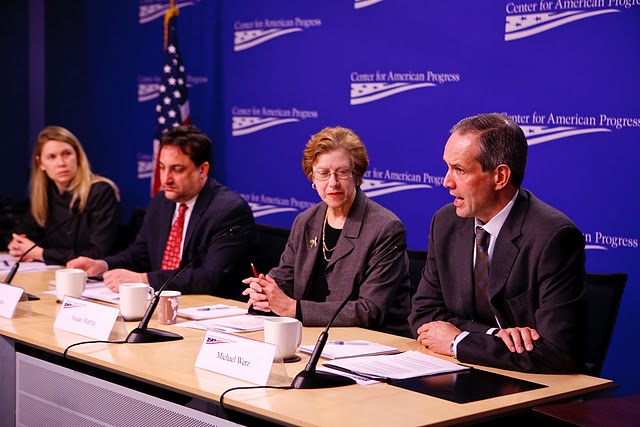
“As we …talk about the interconnections between climate change and migration we need to look at the interconnections in a way that understands what’s positive about the processes of migration and what’s problematic,” said Susan Martin, Herzberg Professor of International Migration at Georgetown University, during a recent event on climate and migration at the Center for American Progress.
While reminding the audience that climate-induced migration will tend to follow already existing patterns, Susan Martin broadly outlined four major intersections between migration and climate change impacts:
“Slow” Migration Pressures:
1. Drought or desertification resulting in a loss or depreciation of livelihoods.
Result: Push working family members to migrate to domestic or international urban centers.
2.Rising sea levels damaging fishing and agriculture opportunities.
Result: Migration to inland regions to reduce future risk.
“Rapid” Migration Pressures:
3. Intensification of natural disasters and damage to infrastructure.
Result: The coping costs increase to the point where they push large numbers of
people to leave their homes. Most individuals migrate internally. Of the four intersections, this is currently the most common.
4.Threats to the availability of food, water, and other natural resources.
Result: Low or high intensity conflict, leading to migrations. The short timeframes and potential large numbers of migrants involved make this driver the most problematic. Differing degrees of internal political stability are factors that can interfere for better or worse.
Yet these relationships are not without controversy. “Environmentalists have tended to see the issue of migration as a way of getting attention to mitigation and have often talked about migration in very alarmist terms,” Martin said. “Migration experts, on the other hand, have been very skeptical about the interconnection.” Instead, they have argued that other push and pull factors outside of climate are much more significant to the migration calculation.
Last week, New Orleans not only hosted Mardi Gras, but also the 2010 ISA Annual Convention.The International Studies Association (ISA) was founded to promote research and education in international affairs, and its annual convention is usually a who’s who of academics, journalists, and policy makers.This year’s conference, with the theme of “Theory vs. Policy? Connecting Scholars and Practitioners,” was no exception.Although chock-full of noteworthy presentations over its four-day run, one seminar was of particular interest: “Forced Environmental Migrants: Challenging the Gap Between Normative Human Rights and ‘Refugee’ Policy.”
Nicole Marshall, a professor at the University of Alberta, argues for environmental migrants’ rights from a philosophical standpoint, as developed in her working paper.She bases her argument off of “moral imperative” (p. 7) and, more specifically, on Kant’s “principle of hospitality.”Theoretically, a person displaced by environmental factors could be defined as a temporary visitor while
in another state and should, therefore, be granted the right of entry into another country because hospitality “is not a question of philanthropy, but of a right” (p. 9).Kant, she claims, also gives us a basis on which to navigate the space between civil rights, as traditionally defined by state-citizen relationships, and human rights; which, ultimately, is the gray area where environmental migrants lie.
Marshall also draws on Joseph Carens’ work on immigration rights using the Rawls’ principles of justice.Carens argues that arbitrary factors are essentially unjust (p. 10) – i.e. where you are born determines your future prospects in life – and need to be rectified in a tangible way – i.e. open borders allow you to move to wherever you decide you have the best future prospects.Since “most environmentally devastating events are arbitrary in location, scope, and impact;” those most egregiously affected by them should be able to move wherever they believe will be without risk and where they can lead a sustained “good” life.
While Marshall makes a case for global moral responsibility and who should take the brunt of it (hint: developed countries who contribute more to climate change and its consequently negative effects), she doesn’t make a particularly convincing case for policy makers or pragmatists, in general, to follow.It is one thing to say the world has a moral responsibility to protect environmental migrants; it is another thing to act upon it.
Update March 3: Here is the video in its entirety from the event. Click on the play button to start.
The Center for American Progress in Washington, DC is hosting an event entitled “The Global Implications of Climate Migration” on March 1, 2010, 10:00am – 11:30am. Speakers will discuss the intersection of climate change, development, and human migration. Here is the brief summary about the event from thier website:
It is inevitable that as global warming intensifies hurricanes, exacerbates drought, and adds to resource shortages, we will need to prepare for extreme conditions and responses, and this includes human migration. Some estimates suggest that as many as 200 million people could become climate migrants by 2050. The panelists will therefore discuss the implications of climate migration with regard to adaptation strategies, frameworks for addressing internal and international movements, and new, comprehensive strategies to deal with unique challenges.
The featured speakers include:
Neil Levine, Director, Office of Conflict Management and Mitigation, USAID Susan Martin, Herzberg Professor of
International Migration, School of Foreign Service, Georgetown University David Waskow, Climate Change Program Director, Oxfam America
Moderated by: Michael Werz, Senior Fellow, Center for American Progress
Click here for more information and to watch the live webcast on the day of the event.
The Copenhagen Summit in December marked an important step in mitigating the negative effects of climate change. It also brought to light the greater need to focus on how climate change has been affecting children. UNICEF UK recognized this gap and in a recent report entitled, “Our climate, our children, our responsibility”. UNICEF not only outlines the risk of climate change to our most vulnerable population, but discusses concrete and important ways these risks can be mitigated by companies, adults, and children themselves.
In the past two installments of the children and climate change series, the dangers of climate change were discussed especially with regards to forced migration. Disease, the breakdown of the
family roles, and the loss of childhood were all explored in depth and the recognition that all the Convention on the Rights on the Child be upheld
to its fullest. UNICEF UK takes us one step further by stressing the need for “engaging children as actors in the climate change agenda rather than treating them as passive observers or victims”. This means not only giving them the voice needed to express how climate change is affecting them, but giving them a voice to bring about meaningful change in the climate change agenda that is occurring now.
For its part, UNICEF has pledged to continue its Millennium Development Goals as well as to build on its ‘’water and sanitation programme [as well as] …providing mosquito nets… water, schools, health clinics, and support for rural communities whose livelihoods are becoming more challenging due to climate change’’. Including children in all aspects of these programs from education to implementation will mean children can move from victim to agent of change. Given the nature of climate change-that it will affect all- means all of us including children should play a part in mitigating the effects.
(Reuters AlertNet) Febraury 12, 2010 – DHAKA, Bangladesh – A building boom in rickety new huts is underway in Korail slum, the biggest temporary residence of landless
people in Bangladesh’s capital.
A growing flood of landless poor, many displaced by climate-related problems, are moving into the canal-side slum, which lies adjacent to Gulshan, one of Dhaka’s poshest areas.
Everywhere, people are busy building new makeshift rooms – in some cases multi-story shanties of bamboo and wood – to accommodate the arrivals.
Bangladeshi researchers estimate that about half a million people each year are pouring to the capital city after losing their homes and livelihoods to problems linked to climate change, including land erosion, worsening storms and sea level rise.
At present around 10,000 people live crammed into each square kilometer in Dhaka, where finding open land has become very difficult. The city, built for a million people in the 1960s, now accommodates more than 12 million and is one of the most densely populated on earth.
Bangladesh is ranked by the U.N. Intergovernmental Panel on Climate Change as one of the countries most at risk from climate change. Models suggest the low-lying nation of 156 million people could lose 17 percent of its land to rising seas, displacing 15 million people by 2050.
I haven’t come across much lately in terms of general reports and news related to climate change and human mobility. However as you can see in the past few posts, there have been some excellent thematic film projects and short videos from around the world that have emerged which highlight this humanitarian issue.
The film “Climate Voices” is an extension of the 6 billion Others project by Yann Arthus-Bertrand, director of Home. The film project not only features testimonials from people around the world who have witnessed change in their daily life because of global warming, but also by the scientific community. 600 people were interviewed
in 17 countries. It was shown last December at the UN Climate Change Conference.
Segments of the 1 hour and 18 minute film are being uploaded to their YouTube Channel. Below is a 2 minute short where François Gemenne, researcher at the IDDRI, explains some of the psychological,
social and cultural consequences of climate change. He says: “One must not forget that it is not just a territory that disappears, not just houses and the living environment, its also cultures, languages and sometimes even nationalities that disappear”. I can also reccommend this segment where climate witnesses and researchers talk about the consequences of displacment due to climate change.



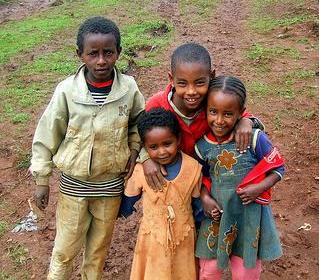 The Copenhagen Summit in December marked an important step in mitigating the negative effects of climate change. It also brought to light the greater need to focus on how climate change has been affecting children.