The annual Global Humanitarian Forum is an independent and impartial global platform where different members of the global society collaborate in order to overcome key humanitarian concerns. The 2009 Forum entitled “Human Impact of Climate Change” took place in Geneva this past June and was focused on the human dimensions and impacts of climate change, in particular for international and development efforts.
The Global Humanitarian Forum has just released the complete video on YouTube from the “Climate change: migration and displacement” focus session at the 2009 Forum. This session was sponsored by the UN High Commissioner for Refugees (UNHCR), and was lead by the following representatives:
Craig Johnstone, Deputy UN High Commissioner for Refugees
Walter Kälin, Special Representative of the UN Secretary-General on the Human Rights
Ndioro Ndiaye, Deputy Director General, International Organization of Migration (IOM)
(moderated by Nisha Pillai, BBC World News)
There are nine parts to the video and the whole session is about an hour and a half. During the session, some key points and questions are raised along with some recommendations on the way forward.
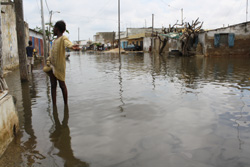
Natural disasters displaced more people than conflicts in 2008. Photo credit: IRIN
(IRIN) September 23, 2009 – Climate related natural disasters like droughts, hurricanes and floods forced 20 million people – slightly less than the population of Australia – out of their homes in 2008 alone said a new study, making a strong case for regularly monitoring displacement in the context of climate change.
A total of 36 million people were displaced worldwide by sudden-onset natural disasters, including earthquakes and landslides. During the same period 4.6 million people were internally displaced by conflicts.
“Had it not been for the Sichuan earthquake in China, which displaced 15 million people, climate related disasters would have been responsible for over 90 cialis cost canada percent of disaster related displacement in 2008,” the study commented.
Using the 2008 data as a test case, the study proposed the ongoing monitoring of disaster related displacement using existing information, such as the Emergency Events Database produced by the Belgium-based Centre for Research on the Epidemiology of Disasters, cross-referenced with various other sources, and individually investigating events to estimate the numbers of persons displaced.
The next step is further research into displacement caused by slow-onset disasters and sea level rise. The study also called for a legal buy zithromax framework to protect people forced to cross a border by a natural disaster.
(UNU-ONY) – The United Nations University Office in New York is organizing a multi-part panel discussion of policy perspectives on human migration as an effect of climate change and on risk reduction and insurance. The event will consist of two panel discussions.
Date: Thursday, September 24, 2009
Time: 10:00 a.m. to 1:00 p.m, Eastern time (UTC/GMT -5 hours)
Venue: The Simon Wiesenthal Center/New York Tolerance Center, New York City
Webcast registration:Click here to register for the event to watch the live webcast. When you register for the event, you will receive a confirmation email with the online location of the webcast.
First Panel: Emerging Policy Perspectives on Human Mobility in a Changing Climate
10:00am – 11:30am
Climate change and associated environmental degradation hold the potential to displace millions of people in coming decades. Estimates of the likely number of people who may be affected by environmental migration vary widely and there have been few efforts to date to systematically analyze the triggers, patterns and policy implications of such trends. An emerging body of inter-disciplinary research is beginning to look at key aspects of these issues with the aim of helping policy makers to make informed decisions on how to prepare for, prevent or respond to climate change related human mobility in an effective manner.
Second Panel: Seal the Deal: How Risk Reduction and Insurance Strengthen the Adaptation Package in a Copenhagen Agreement
11:30am – 1:00pm
The Munich Climate Insurance Initiative (MCII) was launched by Munich Re in April 2005 in response to the growing realization that insurance-related solutions can play a role in adaptation to climate change, as advocated in the Framework Convention and the Kyoto Protocol. This initiative brings together insurers, experts on climate change and adaptation, NGOs, and policy researchers intent on finding solutions to the risks posed by climate change. MCII provides a forum and gathering point for insurance-related expertise on climate change impact issues.
The session seeks to build a network among organizations and initiatives for insurance-related approaches, and to identify pilot projects for the application of insurance-related solutions. Finally, it should facilitate discussion of how to promote loss reduction measures in connection with climate-related events.
For more information and to register for the online event, please visit the UNU-ONY’s website.
Erratic weather patterns and increasing droughts and floods due to climate change are causing people in rural Kenya to migrate to the urban centre of Nairobi. There is evidence that already crowded slums are being overwhelmed by constant arrivals of people who are seeking a better life due to loss of rural livelihoods in the southeastern and western regions of Kenya. Many will also move temporarily to nearby small towns or camps where international protection, aid, and long-term development is needed more than ever before.
Ciara Sutton is a multimedia broadcast journalist who worked on climate change migration issues in Kenya earlier this year as part of a project for her buy cialis online no prescription MA in International Journalism. The project is supported by interviews with international climate change professionals and representatives on the ground from the Red Cross. She authors her own blog “Climate Change and Human Migration in Kenya” where she documented her journey, examines the lives of migrants, and posts related stories.
Below is a recent video from her website which highlights the issue of climate-induced rural to urban migration in Kenya:
(IRIN) September 15, 2009 – “Migration and mobility are always seen as exceptions but they are the norm. Mobility helps people get out of poverty,” s
aid Cecelia Tacoli, senior researcher with London-based NGO the International Institute for Environment and Development. “If people affected by climate change lack access to resources or need to diversify their income sources, this lack should be [addressed] rather than be seen as a problem.”
Tacoli will publish a study, ‘Crisis or adaptation? Migration and climate change in a context of high mobility’, in October.
The numbers
Norman Myers, renowned environmentalist and fellow with Oxford University’s 21st Century School, who has just completed a study for the Swedish International Development Agency, said “hundreds of millions” of people could be driven from their homes by environmental crises and degradation by 2040.
NGO Christian Aid in 2007 estimated that up to 250 million people could be displaced by 2050 as a result of climate change effects. And in 2001 a World Bank study by Susmita Dasgupta predicted that sea level rises could force hundreds of millions of people to move within this century.
Up to 70 percent of people living in cities of 5 million or more live within 1km-2 km of seaways, according to the UN.
The movements of peoples around the world due to climate change affects all of those involved but none is more susceptible to the problems created by climate change migration than children. Current trends show climate change is impacting the developing world much more directly than upon the developed world. Furthermore, 85% of the estimated 2.2 billion children in the world live in the developing world leaving children at greater risk for diseases, exploitation and the psychological impacts that is sure to affect generations to come.
UNICEF’s report entitled, “Climate Change and Children: A Human Security Challenge” outlines these risks including the “increasingly convincing body of evidence that many of the main killers of children (malaria, diarrhoea and undernutrition) are highly sensitive to climatic conditions”. According to a paper by the International Institute for Environment and Development, a decrease in water supply, increased desertification, and rising sea levels among others all mean a rise in forced migration thus “more malnutrition, more disease, more death and injury, more risk of neglect, abuse and exploitation” have all been documented outcomes in youth populations.
The story of Petro, a street child in Malawi highlights this risk. Because of a number of bad harvest seasons in his rural village, his parents had no way to feed him. His father eventually found a job on a plantation far from their village and Petro was left to fend for himself. Ultimately Petro found himself begging on the streets of Blantyre, Malawi’s biggest city. The catalyst for Petro’s move was the drought causing the bad harvest which ultimately caused a breakdown in his family and eventual move to an urban area.
To better understand why a family breakdown could occur so seemingly with ease, it is imperative to understand the role of a child within many developing countries and how the Convention on the Rights of the Child plays a definitive part in changing that role. This, coupled with the need to raise awareness of a new kind of forced migration caused by climate change to hopefully garner greater protection for children set forth in the Convention on the Rights of the Child are vital to ending stories like Petro’s.