
Loss of Food Supply and Livelihoods In the Coral Triangle May Trigger Mass Displacement

[New Zealand Press Association] — An Australian scientist is warning that climate change may drive a wave of economic refugees from southeast Asia and the Pacific to New Zealand and Australia.

Damage done by climate change in the “coral triangle” – an ocean region north of Australia which supports millions of people in coastal communities – may trigger the flood of refugees, according to Queensland University researchers.

More than 150 million poor people live on the shores of the coral triangle, relying on it for food.

As much as 90 percent of those food resources could be gone by the end of the century, university director of the marine studies Professor Ove Hoegh-Guldberg said.

“You start to see that you are now destabilising human communities through the fact that there is just not enough food,” he told the ABC.
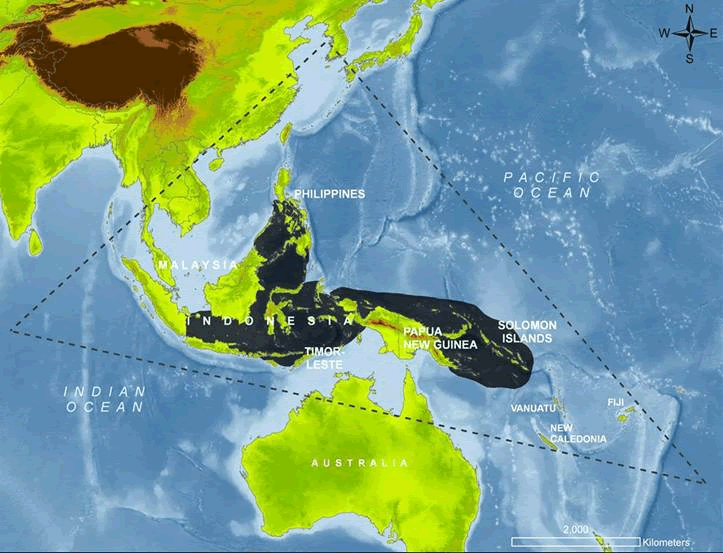
Map of the Coral Triangle. Photo credit: WWF

“So where do they go? We’ll almost invariably see an increased level of pressure on Australia and New Zealand to provide the sort of intake that needs to alleviate these problems.”

A report by the Queensland University marine studies centre found unchecked global warming could take a terrible toll.

The triangle’s waters cover just 1 per cent of the earth’s surface from Indonesia in the west to Solomon Islands in the east and the Philippines in the north, but contain 75 percent of the world’s reef-building coral species and a third of the world’s coral reef fish.

A key form of calcium carbonate, aragonite, which is used by corals and other sea life to create their framework or shells may become less available before the middle of the century.

According to a National Institute of Water and Atmospheric Research (Niwa) scientist at Otago University, Dr Philip Boyd, the world will see a significant `tipping point’ in terms of ocean chemistry by as early as 2030, and the calcium carbonate shells of some organisms may dissolve. About half the increasing amount of carbon dioxide in the atmosphere is reacting with water to form carbonic acid, and increasing the overall acidity of ocean water.

The ocean’s acidity levels have risen 30 percent since the industrial revolution 200 years ago.

The Intergovernmental Panel on Climate Change has said the ocean’s acidity is expected to rise between 30 and 70 percent over this century.

Professor Hoegh-Guldberg told the ABC some coral reefs may already be functionally extinct.

“We see mangrove systems that support fisheries gone and what we see is food security plummet.

“I think we’ve got to take this issue as a global emergency.”

Source: New Zealand Press Association
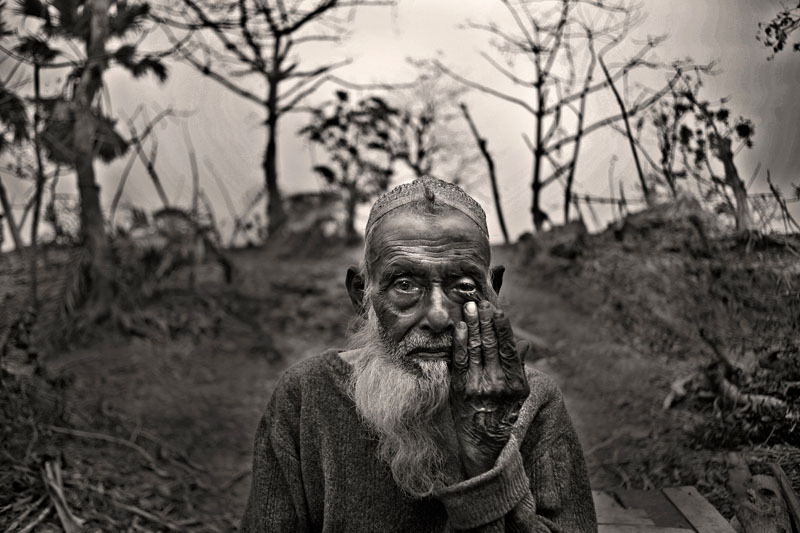
Photography: ‘A Tale of Paradise Lost’

climate_bangladesh02_large

Photo credit: Munem Wasif / Agence VU

[Agence VU] In the last 10 years, farmers like Hatem Ali have had to disassemble and move their tin-and-bamboo houses five times to escape the encroaching waters of the huge Brahmaputra River in Kurigram. This river is swollen out of all proportion by severe monsoon that scientists attribute to global warming and melting ice in the Himalayas. Bangladesh with a population of 140 million people crammed into an area slightly smaller than the state of Illinois is a target of the most vulnerable to global warming.

Some must live with the memory of losing grip on their child when he is swept away by tidal waves at angry awakening of Sidr. Some may still view their lost crops swaying in the fields and today empty, while others have traces of dried tears on their cheeks when they remember their own piece of land swallowed by the fury of the river. Once, villagers happy, they have became climate refugees.

Munem Wasif is a documentary photographer born in Dhaka, Bangladesh, in 1983. A graduate of Pathshala, the South Asian Institute of Photography, Wasif started his journalistic career as a feature photographer for the Daily Star, a leading English daily in Bangladesh. Now he is represented by Agence VU. In this photoset Wasif has put together a series of photographs which aim to tell stories of people who have lost their livelihood and way of living due to the ever growing issue of climate change.

Click here to view the slide show »

Source: Agence VU

Increasing Desertification in China May Create Millions of Environmental Migrants

(The Guardian UK) May 18, 2009 – When the desert winds tear up the sands outside his front door, Huang Cuikun, pictured below in a dried-up riverbed near his home, says he is choked by dust, visibility falls to a few metres and the crops are ruined.

Dust storms hit his village in Gansu province more often than in the past. The water table is falling. Temperatures rise year by year. Yet Huang says this is an improvement. Three years ago the government relocated him from an area where the river ran dry and the well became so salinated that people who drank from it fell sick.

“Life is easier now,” he says, puffing on a cigarette in the new brick home that the authorities have given him. “When we lived in Donghuzhen, we had little water and the crops couldn’t grow. Our income was tiny and we were very poor.”

Huang is one of millions of Chinese eco-refugees who have been resettled because their home environments degraded to the point where they were no longer fit for human habitation. The government says more than 150 million people will have to be moved. Water shortages exacerbated by over-irrigation and climate change are the main cause.

Continue reading this post »

Video: Disappearing Land In Bangladesh

[Al Jazeera] – In Bangladesh, local people are feeling the heat of climate change.

Once a 250 square kilometer island, Kutubdia has been reduced to just 37 square kilometers within a century and more than half of the population has been forced to leave.

And it is not the only island put at risk by global warming.

A rise of just one metre, which some say could be reached this century, means Bangladesh could lose nearly 20 per cent of its land, forcing tens of millions of people to leave their homes.

If sea levels keep rising, millions are at risk of becoming environmental refugees.

On this edition of 101 East, we ask if industrial countries should be held responsible for climate refugees.

Click here to watch part 2 »

Source: 101 East – Al Jazeera

Podcast: UN Expert Explains Environmentally Induced Migration

In a recent interview with the International Relations and Security Network (ISN), Dr. Koko Warner, Head of Environmental Migration, Social Vulnerability & Adaptation Section at the UN University (UNU-EHS), explains the term “environmentally induced migrant” and confirms that action is needed to assist people being affected by climate change.

Dr. Warner declares that “there is not so much exchange between countries on how to deal with the resettlement of people.” She says that so far only a few countries are experimenting with resettling programmes, naming Mozambique, Vietnam, China, Argentina, Brazil, Pacific Islands, and the Maldives.

She also explains that people who are forced to give up their homes and livelihoods are commonly referred to as “climate refugees” by the general public, although currently, they are not defined as such legally.

Listen to Dr. Koko Warner’s full interview (20 minutes) »

“Climigration” – A New Term on the Block


Climate Change + Migration = Climigration

Amidst the ongoing definitional debate over people who are forced to leave their homes due to the creeping effects of climate change, a new term has surfaced in the past few weeks to describe the situation in which this is happening. Robin Bronen, an Alaskan human rights attorney and a National Science Foundation fellow, has coined the term “climigration”. She is part of a growing group of experts calling for an international legal regime to protect the rights of people displaced by the creeping effects of climate change. In a paper published by the UN University, Bronen describes “climigration”:

Climigration results from on-going climate induced ecological changes in a community’s environment that severely impact infrastructure, such as health clinics and schools, as well as the livelihoods and well being of the people residing in the community. Climigration occurs when a community is no longer sustainable for ecological reasons. Climigration differs from migration caused by catastrophic random environmental events. [source]

The concept of climigration implies that there is no possibility of these communities returning home. The term is becoming increasingly popularized in light of the fact that 340 residents of the tiny coastal village of Newtok, Alaska have just voted to relocate 9 miles away, up the Ninglick River. Warming temperatures are slowly melting away the permafrost which acts as natural barrier to protect the village against seasonal flooding. Happening simultaneously is the start of a long and well-planned evacuation program for the residents of the low-lying Cataret Islands. Rising sea levels and salt water intrusion of crops is slowly forcing the locals to seek safer land.

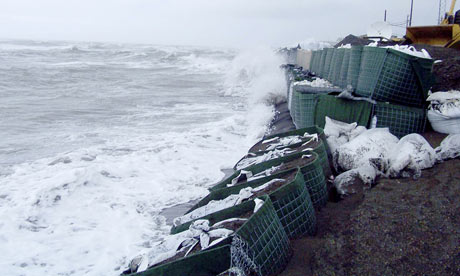
Waves pounding against the sandbagged seawall in Kivalina, Alaska. Photo credit: Mary Sage/AP

“Communities forced to relocate must participate throughout the process, including the decision to relocate in the first place” says Bronen. “Obvious as it may seem through common sense, such rights could be easily trampled in many places and should be defined and protected internationally. There needs to be a new institutional framework that is created, that’s based in human rights doctrines … that facilitates relocation,” Bronen also said.

I have a feeling that “climigration” is a term that will work its way into a specific vocabulary of how we need to resolve some extremely difficult social, environmental, and cultural problems to address the issue of environmental migration.

Article by Dan DaSilva