Posted by Dan DaSilva on July 30th, 2009 | 
Harvard Law School has just published the second issue of thier semi-annual Harvard Environmental Law Review. The issue includes the article Confronting a Rising Tide: A Proposal for a Convention on Climate Change Refugees, which is authored by Harvard Law School lecturers Bonnie Docherty and Tyler Giannini. This is an excellent piece which advocates for formal recognition and protection of those who cross international borders when displaced by climate change. It also provides several advances in regards to the field.
Quoted from the introduction:
“This Article proposes a new legal instrument to confront the issue of climate change refugees. It defines climate change refugees as people whom climate change forces to relocate across national borders.
…
It provides a more in-depth examination of a climate change refugee legal instrument that draws on multiple areas of the law, including human rights, humanitarian, and international environmental law. It looks to legal precedent to provide models and support for its proposals, yet it adapts or departs from this precedent when appropriate to tackle the unique problem of climate change. The Article also crafts an original definition of climate change refugee, details a different combination of components for a binding instrument, and calls for implementing these components as an independent treaty.
…
This Article analyzes the limits of the refugee and climate change frameworks and the value of developing a convention that is separate from these legal regimes.”
It is divided into six parts:
Part I – Introduction
Part II – “Both illuminates the climate change refugee problem and the gap in existing international law and locates the proposed instrument within a larger, interdisciplinary framework for dealing with climate change migration.”
Part III – “Develops a definition for climate change refugee that builds on related law and academic literature yet is designed for the circumstances of climate change.”
Part IV – “Presents and analyzes nine essential components of an effective climate change refugee instrument that provides rights and aid for affected communities while ensuring that responsibility is shared.”
Part V – “Argues that the international community should realize the proposed instrument as an independent convention.”
Part VI – Conclusion
Towards Recognition applauds and endorses this highly progressive article. It is worth having an entire read-through. Please leave any comments or questions you may have about it.
Posted by Dan DaSilva on July 28th, 2009 |
 Photo credit: Cameron Feast/Oxfam (Oxfam Australia) July 27, 2009 – An Oxfam Australia report published today highlights the urgent need for next week’s Pacific Islands Forum in Cairns to address the dramatic effects of climate change within the region.
The Future is Here: Climate Change in the Pacific finds that Pacific Islanders are already feeling the effects of climate change and need greater support now. People are facing increasing food and water shortages, losing land and being forced from their homes, dealing with rising cases of malaria, and coping with more frequent flooding and storm surges.
The report argues that unless wealthy, developed countries like Australia take urgent action to curb emissions, some island nations face the very real threat of becoming uninhabitable.
Pacific leaders will raise the issue of climate change with Prime Minister Kevin Rudd at the Pacific Islands Forum from 4 – 7 August.
Oxfam Australia Executive Director Andrew Hewett said with only months to go until the crucial UN negotiations in Copenhagen in December, it was clear Australia needed to show Pacific leaders it was willing to do its fair share to address one of the most pressing challenges in the region.
Continue reading this post »
Posted by Sabrina Karim on July 26th, 2009 |
Desertification is estimated to affect over 2 billion people in 140 countries if left unchecked, many of whom would be forced to move hundreds of miles to find usable land. So how do we stop desertification?
The UN Dispatch says: Build a wall made out of sand and bacteria!
Build a giant wall. 6,000 kilometers long. Made out of sand. Stuck together with bacteria. No, seriously.
“The threat is desertification. My response is a sandstone wall made from solidified sand,” said Mr Larsson, who describes himself as a dune architect.
The sand would be stabilised by flooding it with bacteria that can set it like concrete in a matter of hours.
Take his word for it; he’s a dune architect. And desertification is not something to mess around with. But with a gigantic, bacteria-reinforced dune wall, buttressing a “Great Green Belt” of trees, unchecked it will not be. As long as we can figure out minor details like politics, funding, and where to obtain “giant bacteria-filled balloons.”
If this seems similar to ad hoc geo-engineering schemes of righting the climate, well, it does to me, too. Except that I’m more comfortable building walls to stop desertification than, say, attaching tubes to giant zeppelins that pump the air full of sulfur dioxide to block the sun and cool the planet.
Source: UN Dispatch
Posted by Dan DaSilva on July 25th, 2009 |
 Photo credit: Samara Freemark Over the next century, rising sea levels will transform coastlines all over the world. According to global reports, the impact will be felt the hardest in such places as Bangledesh and the low-lying Pacific Islands.
However, America is also at risk from the effects of the rising waters. A study which was released last month by two scientists from Louisiana State University, predicts that Louisiana will lose up to 5212 square miles, a chunk of land the size of Connecticut, by 2100.
Samara Freemark, a reporter for The Environment Report, has the story of one of the first communities to be displaced. In this podcast, she meets with the Native American Choctaws tribe chief, Albert Naquin. He is trying to convince the rest of the families to move, but is being met with some resistance.
Listen to the podcast here »
Posted by Dan DaSilva on July 22nd, 2009 |
(Green Party of NZ) July 22, 2009 – Green Party MP Kennedy Graham today challenged Prime Minister John Key to lead the way on climate change response in the Pacific.
“New Zealand should take a leadership role on protecting our Pacific neighbours from the disproportionate burden of climate change they bear. We have a regional responsibility to support endangered, low-lying islands by committing to responsible emissions targets.”
Dr Graham – and his colleague Keith Locke – asked Mr Key questions today in the House about his recent trip around the Pacific and the threat climate change poses to the very survival of several countries in the region.
The Green MPs questioned Mr Key on whether island leaders had voiced concerns over climate change, how New Zealand would respond, and what steps would be outlined at the Pacific Island Forum leaders meeting next month.
Dr Graham said Mr Key’s replies were disappointing, and urged the Prime Minister to take a more proactive role on the Pacific’s impending ecological crisis.
“Small islands bear a disproportionate burden from climate change. Rising seawaters threaten the very existence of nations such as Tuvalu and Kiribati.
“Pacific nations are taking action themselves. Island leaders – in their first-ever United Nations resolution – have asked for a report on the security implications of climate change.
“And many island nations have already set themselves ambitious targets for converting to renewable energy sources. I acknowledge the work the Government is endeavouring to do in this area. But a New Zealand commitment on stronger emissions reductions would support our island neighbours and send a very strong signal that we are serious about our regional leadership.
“And a more definitive stance on welcoming stateless persons –climate change refugees – to New Zealand would show we are serious about protecting our region from the ravages of this impending crisis.”
Source: Green Party of NZ
Posted by Dan DaSilva on July 15th, 2009 |
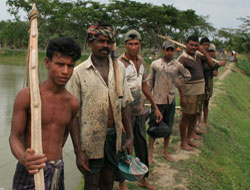 Photo credit: DFID (DFID) July 13, 2009 – The UK is today launching a major action plan to protect 15 million of the world’s poorest people from the devastating impact of climate change in some of most high-risk flood areas on the planet.
A fifth of Bangladesh – an area almost twice the size of London – could disappear if seas levels rise by one metre. This would destroy crops and livestock, spread disease and leave 30 million people homeless.
Experts predict that devastating natural disasters seen in the last three years such Cyclone Sidr and Tropical Storm Aila – which saw millions lose their homes and thousands killed – will become more frequent in the future.
The UK’s country plan will protect people’s lives and livelihoods against more frequent natural disasters and provide practical support to help them adapt for the impact of climate change. The £75m plan will include:
Continue reading this post »
|
|