On June 20th, 2009, World Refugee Day takes place around the globe. This annual commemoration is “marked by a variety of events in more than 100 countries, involving government officials, humanitarian aid workers, celebrities, civilians and the forcibly displaced themselves” (unhcr.org). It is a big opportunity for such UN Agencies like the High Commissioner for Refugees (UNHCR) and individual organizations alike, to create awareness about refugees and other displaced people. According to the UNHCR website, “headquarters and field staff have been planning for World Refugee Day for months and have prepared a wide range of activities focusing on this year’s theme of ‘Real People, Real Needs’ and include light shows, film screenings, photography exhibitions, lectures, panel discussions, food bazaars, fashion shows, cultural performances, concerts and sports contests.”
It is slowly becoming accepted that there is a direct link between the effects of climate change and people being driven from their homes. Given the recent momentum at the Bonn Climate Change Talks to recognize persons displaced by climate change (known by the wider public as “climate refugees” or “environmental refugees”), there is no doubt that many World Refugee Day events will be conveying the issue on some level of relevance. This day could be a time for reflection on not only the fear refugees face of being persecuted for reasons such as race, religion, and nationality, but also reasons of environmental persecution.
Angelina Jolie, who is a longtime advocate and UNHCR Goodwill Ambassador, has recorded a public service announcement (PSA) hoping to draw much needed attention from the general public to the plight of the millions of people around the world who have been forced to leave their homelands.
.
World Refugee Day 2009 resources around the web:
As the Bonn Climate Change Talks wind down this week, delegates and the international media were presented key findings from a new report entitled “In Search of Shelter: Mapping the Effects of Climate Change on Human Migration and Displacement”. The report, which has been released by CARE International and New York’s Columbia University, “explores how environmental shocks and stresses, especially those related to climate change, can push people to leave their homes in search of ‘greener pastures’ … or just to survive.” Researchers questioned more than 2,000 migrants in 23 countries about why they moved. The results point to “a clear signal” that environmental stress is already causing shifts in population. You can access the report here.
As mentioned in my last post, there is a single sentence of the current draft negotiating text found in paragraph 25(e) which refers to human mobility, and calls on nations to prepare plans to adapt to climate change by accounting for possible migrations:
“Activities related to national and international migration/planned relocation of climate
refugees.”
This reference comes well applauded by the international community and is strongly urged to be kept in the final agreement that will be presented at the Copenhagen UN Climate Change Conference in December, 2009. However, key agencies are strongly insisting that the term “climate refugees” be stricken from the draft and be replaced with “persons affected by climate change”. This recommendation comes due to the fact that the term “climate refugee” has no basis in international law and risks weakening existing protection.
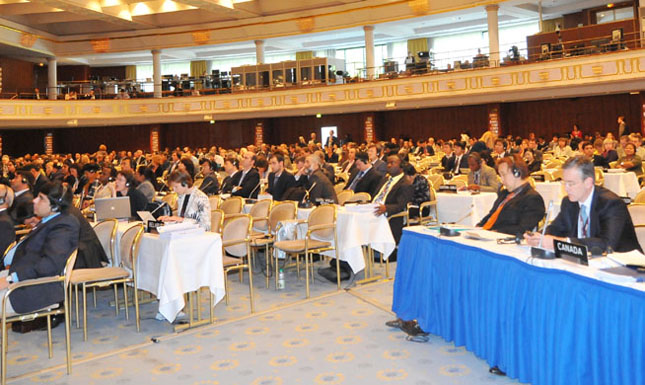
The United Nations Bonn Climate Change Talks continue this week in Germany. According to the Climate Change Talks website, “Delegates from 182 countries meeting in Bonn are to discuss, for the first time, key negotiating texts which can serve as the basis for an ambitious and effective international climate change deal, to be clinched in Copenhagen in December.” A press release today by the UN High Commissioner for Refugees (UNHCR) states that “the next agreement on climate change has to take the humanitarian perspective into account. It is also essential for the agreement to set out a workable approach to help the world counter the impacts of extreme weather events and environmental degradation on vulnerable communities.”
Among the talks is the side event “Climate Change and Forced Migration” which took place today. The event served as a high-level panel discussion looking at the current protection regime and gaps which may impact on aspects of forced migration. It was organized by the Norwegian Refugee Council (NRC) and is in cooperation with key migration agencies such as UNHCR, the International Organization for Migration (IOM), and the United Nations University.
During the event, a new study by the NRC Internal Displacement Monitoring Centre (IDMC) and the Office for the Coordination of Humanitarian Affairs (OCHA) was presented. The study shows that more than 20 million people have been displaced by climate-related sudden-onset natural disasters in 2008 alone. “For the first time, we have a solid indication of the scale of forced displacement as a result of sudden-onset natural disasters in the context of climate change”, said Elisabeth Rasmusson, Secretary General of the NRC, at a press briefing during the talks earlier in the day. “I would like to emphasise that the humanitarian community welcomes the recognition of migration in relation to climate change adaptation in the current draft negotiating text. We urge State Parties to keep this reference in the final agreement.” Rasmusson also said, referring to section 25e of the latest negotiation text.
The ongoing work of the NRC is contributing to massive strides in the direction of formal recognition of environmental migrants. You can read the policy brief based on the findings of the forthcoming NRC-OHCA study here. I will update you further on the outcome of the side event once more information is released.
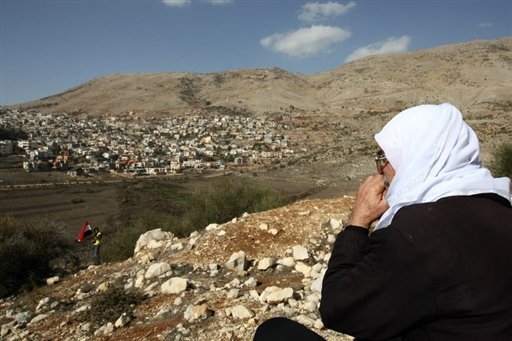
A Syrian man sits in the village of Ain al-Tineh, 70 kms southwest of Damascus. Photo credit: AFP
June 2, 2009 (AFP) – Some 160 villages in northern Syria were deserted by their residents in 2007 and 2008 because of climate change, according to a study released on Tuesday.
The report drawn up by the International Institute for Sustainable Development (IISD) warns of potential armed conflict for control of water resources in the Middle East.
“The 2007/8 drought caused significant hardship in rural areas of Syria. In the northeast of the country, a reported 160 villages have been entirely abandoned and the inhabitants have had to move to urban areas,” it said.
In Syria and also in Jordan, Israel and the occupied Palestinian territories, “climate change threatens to reduce the availability of scarce water resources, increase food insecurity, hinder economic growth and lead to large-scale population movements,” the report said.
“This could hold serious implications for peace in the region,” the Canada-based institute said.
There are two films that you should be aware of if you are following the journey of the Cataret Islanders and their ongoing relocation to nearby Bougainville. The Next Wave is a short documentary that received a Jury Award at the Ninth Annual Media that Matters Film Festival. Produced by Jennifer Redfearn and Tim Metzger, The Next Wave “presents the human face of climate change and a people faced with the loss of a land in which their identity is rooted. It is a portrait of a community and a critical moment in history.” You can read more about The Next Wave and watch the trailer here.
The Next Wave is a short version of the film Sun Come Up, which is a longer-work-in progress. Sun Come Up “follows the relocation of some of the world’s first climate change refugees – the Carteret Islanders, a matrilineal community living on an island chain, 50 miles off the coast of Papua New Guinea” (suncomeup.com). You can watch the trailer of Sun Come Up here.
The International Organization for Migration (IOM) has just released a new policy brief entitled Migration, Climate Change and the Environment. The eight-page brief presents key information and analysis on the interplay between the three factors. It is designed as a general introduction to the topic of environmental migration and presentation of the perspective and involvement of the IOM in this field.
According to the paper, “No one agency or stakeholder alone holds the key to the solutions and IOM wishes to play its part in collaborative approaches.” IOM also highlights the need to raise policy and public awareness of the need for concerted action to address the challenges presented by the climate change, environmental degradation, and the migration nexus.